
Manual rain gauges: how to measure rainfall and use one in the garden
A manual rain gauge measures rainfall at a specific location in millimetres. To use it correctly, install it upright in an open space, read the graduated glass at eye level and empty it after each reading. Above all, remember this conversion: 1 mm of rain equals 1 litre of water per square metre.
It rained last night. The leaves are still glistening, the terrace is wet and the watering can can probably wait. But how much water did your garden actually receive?
That is exactly what a rain gauge tells you: it puts a precise figure on that impression. With no batteries, connection or app, this small instrument helps gardeners track rainfall and decide whether watering is needed. You just need to know where to put it and how to interpret the reading.
How does a manual rain gauge work?
The principle is simple: an opening collects rain, which accumulates in a graduated container. The level in the glass shows how much rain has fallen since it was last emptied.
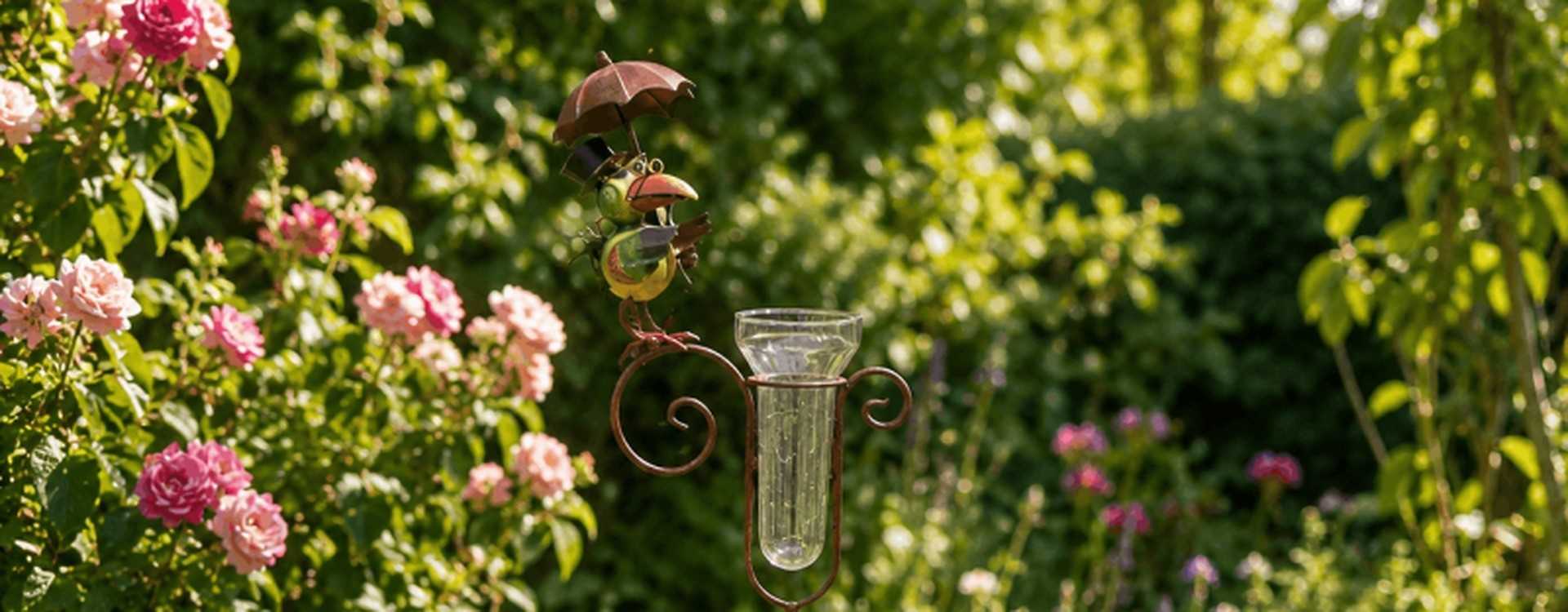
Some models have a separate funnel that directs water into a narrower tube. In others, particularly decorative rain gauges, the graduated glass collects rain directly through its flared opening.
A rain gauge therefore measures rainfall over a defined period. A reading of 12 mm might represent a single shower, a whole day or several days. It all depends on when the glass was last emptied.
Why must you use the right glass for your rain gauge?
The shape of the container and the size of its opening directly affect the measurement. When a wide funnel directs water into a narrower tube, the water rises higher in the glass. The graduations are calibrated to account for this difference.
Always read the rain gauge's own scale. Measuring the water depth with a ruler or adding a wider funnel would give an incorrect result.
For the same reason, a broken glass must be replaced with one suited to the rain gauge.
What do millimetres of rain represent?
One millimetre of rain equals one litre of water falling on one square metre. Weather services, including Météo-France, use this relationship to express rainfall totals.
Imagine a flat surface of one square metre where all the rain remains without soaking into the ground. A layer of water one millimetre deep would contain exactly one litre.
| Rain gauge reading | Water falling on 1 m² | Water falling on 10 m² |
|---|---|---|
| 2 mm | 2 litres | 20 litres |
| 5 mm | 5 litres | 50 litres |
| 10 mm | 10 litres | 100 litres |
| 20 mm | 20 litres | 200 litres |
To calculate the volume received over an area, simply multiply the rainfall in millimetres by the area in square metres.
For example, a reading of 8 mm over a 20 m² vegetable patch corresponds to:
8 × 20 = 160 litres of water falling on the vegetable patch.
This calculation tells you the volume received. It does not mean that all this water will remain available to plants. Some may run off, evaporate or drain quickly through the soil.
Where should you install a rain gauge in the garden?
Install the rain gauge in an open spot, with its opening level and its support firmly secured.
An open area of lawn or vegetable patch is generally better than a spot under a tree or against a wall. Avoid places reached by automatic irrigation, as the rain gauge would then collect both irrigation water and rain.
Before installing it, check the following:
- the container must remain upright;
- the support must be pushed far enough into the ground;
- splashes from the ground must not reach the glass;
- the rain gauge must be easy to reach for taking readings.
Meteorological guidelines recommend keeping rain gauges well away from trees, buildings and other obstacles. In a private garden, it is not always possible to meet the distances used at weather stations. Simply choose the most open spot that best represents your garden.
At what height should a rain gauge be placed?
There is no single height that suits every model. Decorative rain gauges on stakes should be installed at the height intended by their support.
Push the stake far enough into the ground to prevent it leaning in the wind. The glass opening must remain level. A slightly tilted rain gauge will collect less rain and give a less reliable result.
How do you read the graduated glass correctly?
For comparable measurements, take readings at a regular time, such as every morning.
- Keep the glass upright. Carefully remove it from its holder without spilling any water.
- Bring your eyes level with the water. Looking down from above can give a misleading reading.
- Read the millimetre scale. If the water forms a small curve against the glass, use the bottom of that curve as your reference.
- Record the value and the period. For example: “7 mm between Tuesday morning and Wednesday morning”.
- Empty the glass after taking the reading. The next measurement will then start from zero.
If the rain gauge shows 12 mm, your garden has received the equivalent of 12 litres of water per square metre since the glass was last emptied.
You can also take a reading after each spell of rain. Two successive readings of 4 mm and 6 mm give a total of 10 mm.
What should you do if the rain gauge overflows?
If the glass overflows, the exact rainfall amount can no longer be calculated. You only know that the total exceeded the highest graduation.
For example, if a glass marked up to 35 mm overflows, more than 35 mm of rain has fallen, but you can no longer determine exactly how much.
When heavy rain is forecast, you can take several readings during the event and add the results together.
Do you still need to water after rain?
A rain gauge measures water falling from the sky; it does not directly measure moisture around plant roots.
A 10 mm reading is useful information, but you also need to consider soil type, temperature, wind and the needs of each plant.
- In the ground: check moisture below the surface, near the roots.
- In a pot: check the compost, as foliage or shelter may prevent rain from reaching it.
- For newly planted plants: check the root ball itself, as the roots have not yet spread far into the surrounding soil.
Rain falling on already damp soil has a different effect from rain falling on very dry ground. Some water may also run off before soaking in.
The best approach is to combine your rain gauge reading with a look at the soil. Gently move the mulch aside and check the moisture a few centimetres below the surface before reaching for the watering can.
Is a decorative rain gauge accurate?
Yes, a decorative rain gauge is accurate and can effectively measure the amount of rain falling in your garden. With a correctly calibrated glass and an upright installation, it provides a reliable reading in millimetres, well suited to tracking rainfall and managing watering.
The decoration surrounding the glass, whether a bird, flower or countryside scene, does not prevent it from working properly. The rain gauge remains a measuring instrument while adding an original touch to the garden.
When choosing a model that is pleasant to use, look at:
- how easy the numbers are to read;
- the stability of the support;
- how easy the glass is to remove and clean;
- the availability of a compatible replacement glass.
Lézard du Jardin's decorative rain gauges combine a useful measurement with an attractive outdoor ornament. Birds, flowers, animals and countryside scenes fit naturally into a flower bed, beside a vegetable patch or in the middle of a lawn.
How should you care for a rain gauge?
A clean glass is easier to read, and a clear opening collects rain properly. Each time you empty it, remove any leaves, insects or small debris.
A rinse with clean water is usually enough. If deposits build up, use a soft brush. Avoid abrasive products and vigorous rubbing over the graduations.
After strong winds, also check that the stake has not shifted and the glass is still upright.
Should you bring the glass indoors in winter?
If frost is forecast, we recommend bringing the graduated glass indoors. Water can collect inside and freeze. As it expands, it may crack or break the glass.
Emptying it once is not enough if more rain falls before the temperature drops. During freezing weather, keep the glass sheltered and put it back when temperatures rise above zero.
A standard decorative rain gauge is not designed to measure snow precisely. Snow can block the opening and melt gradually, long after it has fallen.
Frequently asked questions about rain gauges
Is 1 mm of rain a lot of water?
One millimetre of rain equals 1 litre of water per square metre. This is a small amount and may not be enough to moisten the soil deeply.
Should you empty a rain gauge every day?
To track daily rainfall, read and empty the glass each day, ideally at the same time. If you wait several days, the reading will represent the total for that whole period.
Can you use a kitchen measuring jug?
No. A measuring jug shows a volume in millilitres, while a rain gauge shows a rainfall depth calculated from its collection area. You therefore cannot read the millilitres on a measuring jug directly as millimetres of rain.
Why does my rain gauge show less than the weather app?
The app may display a forecast or an estimate calculated for a nearby area. Rainfall can vary considerably over just a few kilometres. Also check that both figures cover the same period.
Can you replace just the graduated glass?
Yes. At Lézard du Jardin, all our rain gauges have a replacement glass suited to their model. If it breaks, you can replace just the graduated glass and continue enjoying your rain gauge without changing the whole decoration.
The rain gauge: a small but useful garden tool
Simple to install and easy to read, a manual rain gauge tells you how much rain your garden has actually received. It helps avoid unnecessary watering and gives you a better understanding of your plants' needs through the seasons.
A decorative model also becomes a feature in its own right. Useful, visible and full of charm, it offers a different way to look at the rain while giving gardeners practical information.
Discover our collection of decorative garden rain gauges.
Sources consulted
- Météo-France – Understanding and measuring precipitation
- Météo-France – Direct-reading rain gauges
- Met Office – How we measure rainfall
- Royal Horticultural Society – Garden watering advice
Leave a comment